The Road Nobody Talks About
I was thirteen, maybe fourteen. Old enough to be curious, young enough to not be told everything.
We were somewhere on the road between Rajouri Garden and Zakhira on an early Delhi evening, and nobody had told me exactly where we were going. What I did know, pieced together from the hushed conversations in the car, was that we were going to meet someone. Someone the adults in my family spoke about in that particular tone they reserved for things they half believed and fully feared.
They called him Chawal Waaley Baba. Loosely translated, the man who reads rice. A panditji, a Hindu priest, who presided over a small hidden temple in West Delhi and was said to be blessed with something that went considerably beyond the usual domain of priests. Not just ritual knowledge or scripture. Sight. The kind that did not require you to say a word.
The car was tense in that quiet way that families get when something important is at stake. There was a new business on the horizon, one of my relatives was stepping into something significant, and the kind of uncertainty that comes with new beginnings had settled over everyone like a low cloud. People were talking, but carefully. The way you talk when you are not sure who or what might be listening.
I sat in the back and watched Delhi go by.
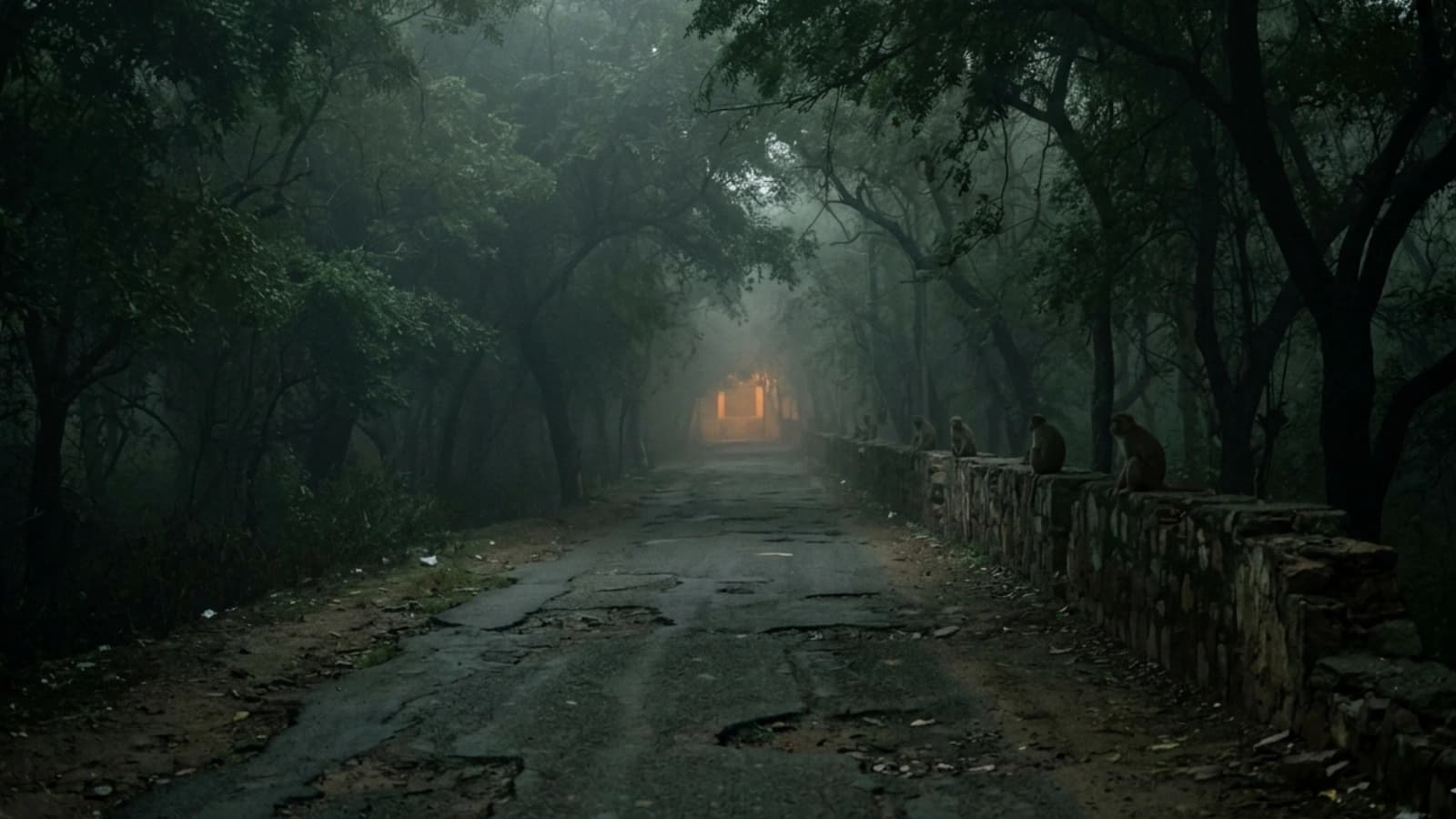
Past Moti Nagar the roads started to thin. The wide arteries of West Delhi gave way to narrower streets, and then narrower still, until we hit a stretch near a nala running alongside a small bridge, with the remnants of a flyover looming on the left, and my Maamu swung the car into a hairpin left that I did not see coming. The road that opened up was something else entirely. Single lane, broken in places, the kind of road that the city had simply forgotten about. On the left the nala continued to run its quiet course before eventually giving way to thick growth. On the right, dense forest pressed in close, trees catching the last of the early evening light. For a few minutes it felt less like Delhi and more like somewhere that Delhi did not know existed.
Two, maybe three hundred metres down that road and it appeared.
A small Mata's temple, tucked away from the world as if by design. No signboard, no fanfare. Just a structure that felt like it had always been there, older than the road that led to it. Monkeys moved along the boundary wall with that proprietorial ease they have in such places. A small crowd had gathered outside, people sitting, waiting, talking quietly amongst themselves.
And the air felt different. Charged is the word that comes to mind, though I could not have articulated it then. It was the feeling of a place where people brought their heaviest questions and left a little of themselves behind each time.
I stepped out of the car and had absolutely no idea what I was walking into.
What They Said About Him
It was my aunt who first put the fear in me.
Somewhere on that drive, in between the murmured conversations about the business and the family and what they were hoping to hear, she leaned in with the particular energy of someone who has been waiting to tell a story.
She told us about a man she knew, a friend of a friend, the kind of remove that makes a story feel both safe and credible. This man had gone to see Chawal Waaley Baba with his wife and parents in tow, the way families do when they want to present a united front to the universe. A general consultation, nothing dramatic. He had paid for the private session, the real one, the one behind closed doors.
Baba had taken one look at him, struck the rice, and without any preamble or ceremony looked straight at the man and said, in that flat unhurried tone he was known for, "woh jo doosri waali hai, usse door reh. Parivar ko nigal jayegi. Apne ghar pe dhyan de." (The other woman in your life, stay away from her. She will consume your family. Pay attention to your own home.)
He did not explain who the doosri waali was. He did not need to. The man's wife had gone very still. His mother had looked at the floor. And the man himself had said nothing, which in that silence said everything.
There was nervous laughter in the car after she finished. The kind of laughter that is only partially about finding something funny.
The unspoken message was clear. This was not a man who softened things for your comfort. He said what he saw, in the room, in front of whoever happened to be present, and if that created consequences you had to live with, that was between you and whatever you had done. He had no interest in managing your feelings about it.
I was thirteen or fourteen, sitting in the back seat, and I had done nothing wrong.
Nothing that came to mind immediately, anyway.
The Durbaar
The temple compound was modest but alive.
A decent sized gathering had arranged itself outside in that organic way that crowds do in such places, no formal seating, no announcements, just people who knew to come and knew to wait. Some sat on the ground, some on low wooden benches along the wall. Families, mostly. A few lone visitors. Everyone carrying something invisible that they had brought from home.
Chawal Waaley Baba arrived without ceremony.
He was not what I had imagined from the car conversations. No dramatic entrance, no flowing robes. Just a man of middling build who carried himself with the quiet authority of someone who had nothing to prove. He settled into his place at the front and the murmur of the crowd dropped several notches almost immediately.
In front of him sat a large bag of rice.
That was it. No elaborate setup, no instruments, no props beyond that one ordinary bag of uncooked rice and whatever he carried inside himself.
The durbaar began.
He would call someone forward, a person from the gathering with a query weighing on them, and ask them to reach into the bag and take a fistful of rice. Just hold it, he would say. The person would close their fist around the grains and hand it to him or place it before him, and then Baba would position the rice loosely on the surface in front of him, draw back, and strike it. Like a carrom striker. Sharp, deliberate, without hesitation. The grains would scatter and fly and before the sound of it had settled he would already be speaking.
Eyes closed. Head slightly tilted. Voice unhurried.
He did not ask questions. He did not fish for information. He simply spoke, in no particular order, jumping between things that had happened and things he said were coming, and the crowd would lean in collectively, holding its breath. And then someone would gasp. And then someone else. The kind of gasps that are involuntary, that escape before you can compose yourself.
For solutions, the upays, he would prescribe poojas and remedies, and redirect the person to his next in command who would explain the how and the when. He did not extract money from the durbaar crowd. That was not where the transaction happened.
The private consultation was a different matter entirely.
For families like ours, who had come with specific questions and the means to ask them properly, the arrangement was to wait. Wait for the durbaar to wind down, wait for the crowd to thin, and then be called into the room where Baba met people one on one. That was the inner circle. That was where the real conversations happened.
We settled in and waited.
My family filed into position with the quiet focus of people who had rehearsed what they wanted to ask. I looked around at the gathered faces and felt the particular sensation of being somewhere that operated by rules I did not fully understand.
The Boy in the Driver's Seat
At some point it was decided, the way things are decided for teenagers without much consultation, that I would wait in the car.
The family had moved inside for their turn and I had been deposited back at the Tata Estate with the general instruction to sit quietly and not do anything. Standard issue advice that I received regularly and followed selectively.
The car was parked on that broken single lane road, forest pressing in on the right, the last of the early evening light filtering through. It was quiet out there. The kind of quiet that makes you very aware of yourself.
I lasted approximately four minutes doing nothing.
What happened next was entirely logical from where I was sitting. The front seat was right there. The steering wheel was right there. And I was a teenage boy who had grown up around cars, had opinions about cars, and had spent a reasonable portion of his young life imagining himself behind the wheel of one.
I climbed over.
Settled into the driver's seat with the comfort of someone who belonged there. Hands on the wheel, eyes on the road ahead, that narrow lane stretching out between the trees. In my head I was already moving, cutting through traffic with the casual authority of someone who had been driving for years, threading through gaps, overtaking with precision, the whole performance.
And then I saw the key.
Still in the ignition. Maamu had left the key in the ignition.
I looked at it for a moment. Just sitting there. Waiting.
Now, I want to be clear that what followed was not a decision so much as a sequence of events in which my hand was simply closer to the key than my better judgement was. I reached out and turned it.
The Tata Estate had other ideas.
What I had not accounted for, in my enthusiasm for the driving experience, was that I had also been enthusiastically playing with the gear stick. The car was not in neutral. The engine did not start so much as the car lurched violently forward, a single aggressive jump that lasted half a second and felt like considerably longer.
I let go of the key. The car stopped. I sat very still.
The silence that followed was enormous.
I looked around to confirm that nobody had seen this. Climbed back to the rear seat with a casualness I absolutely did not feel. Stared out of the window. Arranged my face into the expression of someone who had been sitting quietly the entire time and had no idea what anyone might be referring to.
Outside, the trees said nothing.
He Already Knew
Inside the room, from what my mother told me later, things had been going smoothly.
Baba had worked through the family's questions with his usual economy of words. The business, the general wellbeing, the things that had been keeping everyone quietly anxious on the drive over. The rice had been struck, the grains had scattered, and he had spoken with that same flat authority that had held the durbaar crowd in silence.
And then, mid-session, he stopped.
He looked at my mother. Just looked at her, for a moment that she described as lasting longer than it should have. Then he asked, in that unhurried way of his, why she had left her son in the car.
My mother said she had assumed he would be fine.
Baba shook his head slightly. "Woh chanchal hai. Abhi bhi kuch kar hee rha hoga." (He is a restless one. He must be up to something even as we speak.) "Chaabi gaadi mein hi hai kya?" (Is the key still in the car?)
My Maamu was on his feet before the sentence was finished.
Now cut back to the car.
I was in the rear seat, assembled into my best impression of innocence, when I saw him. Maamu, coming down that broken road at a pace that was not a walk. The expression on his face was the specific expression of a man who has been embarrassed in a room full of people and is now coming to address the source of that embarrassment.
I had approximately eight seconds to decide how to play this.
But here is the thing. In those eight seconds, something shifted. Because Maamu had been inside. With Baba. And Baba had sent him out here. Which meant Baba had known. About the car, about the key, about the lurch, about all of it.
And if he knew about the car.
My mind, with the particular efficiency of a teenage conscience, immediately began filing through everything else. The magazines, carefully stashed in a location I will not be disclosing even now. The school trip money, which I had informed my parents cost exactly twice what the school had actually charged, the difference having been redirected toward more pressing personal priorities. The various other items stored in the mental folder labelled things that cannot under any circumstances reach my parents.
If he could see the car from inside that room, what else could he see.
The earful I received from Maamu when he reached me was thorough and deserved and I absorbed it in complete silence, which was not my usual approach to being told off. I was too busy with the more urgent question of exactly how much this man knew and whether any of it was about to be said out loud in front of my family.
I walked back inside with the energy of someone approaching a situation that could go several different ways.
The Room
They called me in shortly after.
The room was small and certain. That is the only way I can describe it. The kind of room that has absorbed a thousand conversations and holds them quietly in its walls. Light blue paint, slightly worn at the edges. A large framed photograph of Mata Vaishno Devi behind where Baba sat, garlanded and presiding over everything. Shelves lined with religious texts, thick spined and well used, the kind that are consulted rather than displayed. The whole room smelled of incense that had been burning for years.
Baba sat on a diwan, unhurried as always.
To his side, two single chairs for the people being consulted. My mother squeezed onto the diwan next to him along with whoever else had come in with us. I was directed to one of the chairs, which felt significant in a way I could not quite place. Being given a chair in that room meant being addressed directly.
He looked at me for a moment without speaking.
Then, with the faintest trace of something that was almost amusement, he said, "Bahut shaitaani hai tujh mein." (There is a lot of mischief in you.) "Padhai pe dhyan de. Maa ko pareshan mat kar." (Focus on your studies. Stop troubling your mother.)
I nodded. The nodding felt safer than words.
He paused, closed his eyes briefly, and then said I would become an engineer. Said it the way you say something you already know, not a prediction so much as a statement of fact that the future had not caught up with yet.
Then he said I would settle abroad. That my passport should be made without delay.
I sat very still for that part.
Not because of the abroad prediction, which meant little to a fourteen year old, but because he had moved on and I could feel him moving through things, and I had no way of knowing where he would stop next. There were things in that mental folder, the one labelled things that cannot reach my parents, that I was very invested in keeping there. Every sentence he began, I waited to hear where it would land.
He never went there. Or if he did, he chose not to say it out loud, which I have always chosen to believe was a small mercy extended in my direction.
What he did say was enough. The naughtiness called out, the engineer confirmed, the abroad mentioned, and beneath all of it the quiet unnerving sensation of being in a room with someone who seemed to have already read the file on you before you walked in.
I came out into the evening air and said nothing for a while.
Ancient Wisdom or Convenient Theatre
The ride back was something else entirely.
The same road that had felt merely unfamiliar on the way in now felt genuinely other in the dark. The forest on the left had closed in completely, the broken lane lit only by the headlights, the nala running its quiet course somewhere to the right. Nobody spoke much. The kind of silence that follows an experience that everyone is still privately processing.
I stared out of the window and thought about what it would mean to have that kind of sight. To just know. To close your eyes in a room and see what was happening two hundred metres away in a parked car. The world would be a very different place from that vantage point. Everything available, nothing hidden.
It was an intoxicating thought for a fourteen year old. And a deeply uncomfortable one.
Over the years that followed, Chawal Waaley Baba became a recurring presence in our family's life. And the honest accounting of that period is more complicated than a simple verdict of believer or sceptic allows.
There were predictions that landed. Not gently, not vaguely, not in the way that horoscopes land when they are written broadly enough to fit anyone. Specific things, about specific people, about what was happening in their lives at that precise moment. The kind of accuracy that you cannot comfortably file under coincidence and move on. It sat with you. It made you call someone and ask if what he had said was true, and when they confirmed it, you put the phone down and sat quietly for a while.
And then there were the solutions.
The upays grew more elaborate and more expensive as the stakes of the questions grew. Poojas that required specific arrangements, specific materials, specific people to perform them. The costs accumulated. And with the costs came that uncomfortable question that you didn't want to ask out loud because asking it felt like a betrayal of everything you had witnessed. Was this connected to what he could see, or was this simply what came after. Was the gift and the commerce two separate things, or were they designed to work together.
I never fully resolved that question.
What I can say with honesty is this. The engineering did come true. But abroad never happened. The business venture that had brought the family to that temple on that early evening in the late nineties, the one everyone had been quietly anxious about on the drive over, did not survive. Several of the future predictions, stated with the same flat authority as everything else, simply did not come to pass.
But here is the thing that stays with me.
The past he got right with an accuracy that defied easy explanation. The present he saw in real time, a boy in a car two hundred metres away, fiddling with a gear stick. It was the future that got tricky. And by the time you discovered that the future had not arrived as described, you had already spent years inside the belief that it would. Because the present had been so undeniable, so precise, so impossible to dismiss, that handing him the future had felt like the only reasonable thing to do.
That is the mechanism. Not necessarily deception, perhaps not even conscious design, but a pattern as old as the practice itself. Show someone their present with impossible accuracy and they will hand you their future without question. And by the time the future arrives, rewritten by life and chance and choice, the memory of being truly seen will always outweigh the predictions that never came.
We drifted away eventually, as families do from such things. Not with anger or disillusionment exactly, more with the quiet recalibration that comes from enough time and enough clarity. He remains a memory of a particular chapter, vivid and unresolved, the way the most interesting chapters tend to be.
I still do not know what to make of him entirely. I am not sure I am supposed to.
"We should not pretend to understand the world only by the intellect. The judgement of the intellect is only part of the truth."
— Carl Jung
Somewhere on a broken lane in West Delhi, on an early evening that turned to pitch dark before we found our way back, a man struck a fistful of rice and said things that had no business being said.
Make of that what you will.
Comments
Loading comments...