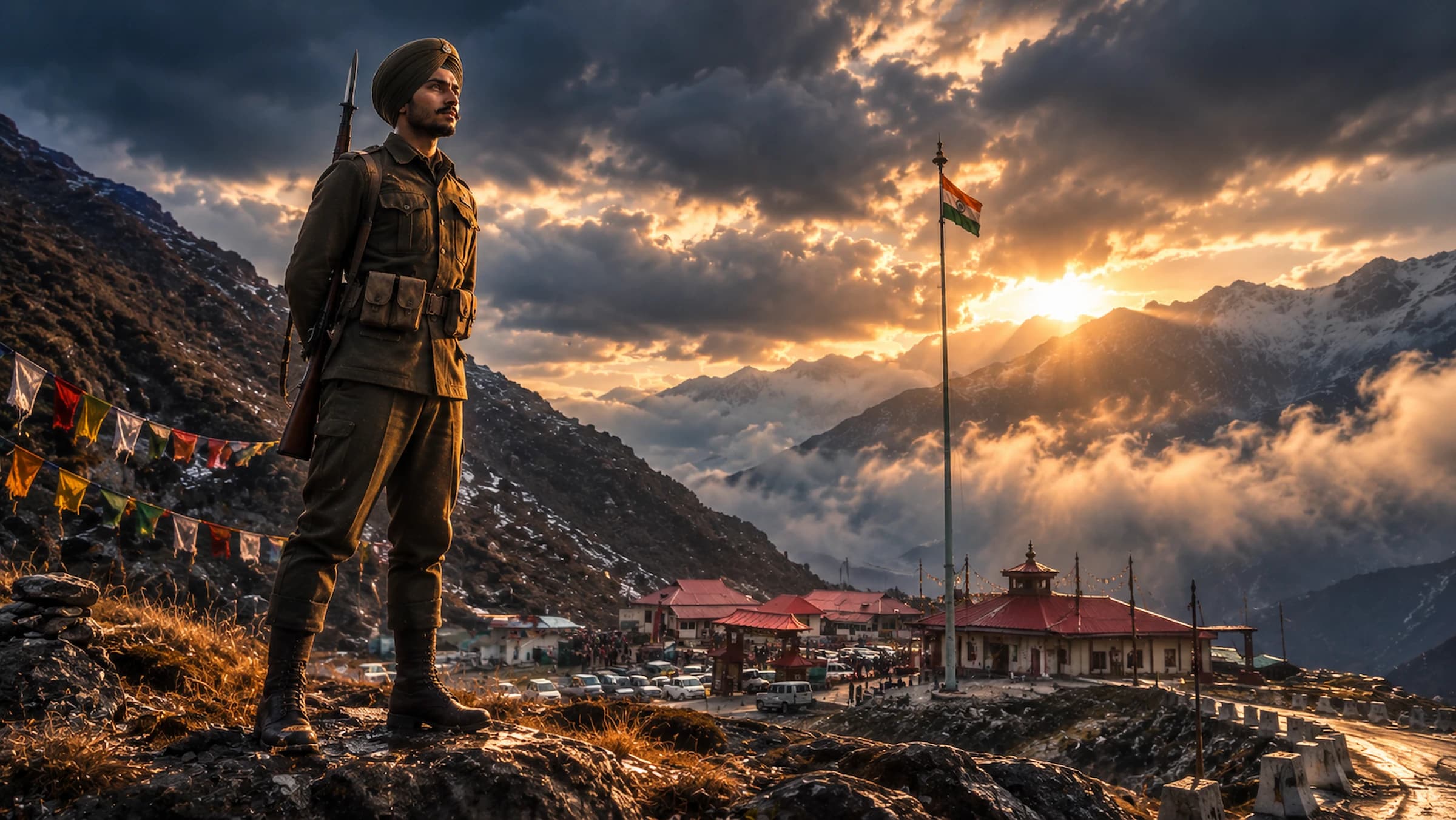
The Road to Nathu La
There are postings, and then there are postings that become chapters of your life you return to long after they are over.
Sikkim was that for us.
My father, an officer in the Indian Army, was first posted to Chungthang, a small town in North Sikkim where the Teesta ran loud and wild below, the kind of river that announces itself before you see it. I was in Class 3. And for a few months, I was the happiest I had ever been in my short life, for one very specific reason.
There was no school.
Not because school did not exist, but because the logistics of an army posting in that terrain did not always account for a child's academic calendar. And so I had the mountains, my younger brother, and an unstructured expanse of days that felt, to an eight year old, like the universe handing you a gift with both hands. We ran. We explored. We watched the clouds come in over the peaks with the particular intimacy that only happens when you are small and the mountains are very large and nobody is telling you to sit still.
Life in Chungthang had its own rhythm. Food came from the mess, and the man behind it was one of those rare cooks whose reputation travels faster than he does. Rakesh. Whatever he made, it was worth waiting for. And waiting was something his dog had mastered completely. A wild mountain dog, loyal beyond reason, trained beyond what you would expect from any dog let alone one from those hills. He never entered the mess premises. Not once. He simply stationed himself outside and waited for Rakesh with the patient certainty of someone who knows exactly where he belongs.
We, on the other hand, had less dignity about waiting.
My younger brother and I had identified, early in our Chungthang tenure, that the mess rations included tins of Milkmaid condensed milk. And we had further identified that Rakesh, if approached correctly and at the right moment, could be persuaded to make certain tins disappear from the official inventory and reappear in our hands. We would prise the lid off and eat it straight, thick and impossibly sweet, with the focused joy of children who know they are getting away with something.
The dog watched us with what I choose to remember as quiet approval.
Chungthang deserves its own post, and it will get one. There is too much there, too many memories, too many stories still waiting to be told. Consider this a teaser and a promise.
I did not know then that I was storing memories I would spend decades returning to.
Six months. That is all we got. Orders came, as they always do, without much ceremony. And just like that, the chapter closed.
Then dad got posted to Gangtok, the capital, and school resumed, and life took on the shape that army postings give to families. Routine with interruptions. Normalcy punctuated by something extraordinary around every corner.
But the extraordinary in Sikkim was not the exception. It was the baseline.
Because Gangtok was not the end of the road. It was the beginning of several.
Siliguri to Gangtok was the initiation. The plains just quietly disappear behind you and the mountains take over before you have fully registered the handover. Gangtok to Chungthang was familiar territory, known and loved, the Teesta keeping pace alongside for stretches before the road climbed away from it. Chungthang to Thangu was a different league entirely. Higher, quieter, the air doing something to your lungs that you couldn't quite name. And then there was Gangtok to Nathu La. The one I ended up knowing best of all. Because in the two years we were there, we had no shortage of guests, relatives, family friends, people passing through, and every single one of them wanted to go to Nathu La. Which meant I went too. Every time. The road that climbed through cloud and switchback and silence and arrived, eventually, at one of the most charged stretches of land in the country. The India-China border. Where the air was thin enough to remind you that you were somewhere serious.
Every single one of these routes had one thing in common.
They made us sick.
Me and my younger brother. Both of us, reliably, without fail.
Now, this would have been manageable had our father been the kind of man who was indifferent to his vehicles. He was not that kind of man. Not even close. A tank specialist by trade, a petrol head by nature, he had a relationship with machines that went well beyond the professional. He loved his rides. He cared for them. In the first year it was the Jonga. Sturdy, dependable, built for exactly this terrain. In the second year, after he became OC Workshop, it was the Gypsy. And both of these vehicles had, sitting in the back seat, two small boys who were a rolling threat to everything he held dear.
He knew it. Every time we piled in, I could see him do the calculation.
My mother, who deserves a separate medal for services rendered to family travel, had figured out the solution long before the problem had a chance to become a crisis. Avomin. The motion sickness tablet. One each, before every journey, without exception. Did not matter which road, did not matter how long. Avomin went in, and within twenty minutes, we went out. Just drifted off, heads against the window, completely horizontal on the back seat, blissfully unconscious while the hairpins did their worst.
My father's vehicles were safe.
This continued into the second year. And then, somewhere along the way, quietly and without announcement, something changed. The stomach settled. The body stopped arguing with the altitude. I started staying awake on the drives. Actually looking out the window. Actually seeing the mountains instead of staring at a fixed point on the horizon and negotiating with myself.
I had become, without noticing it happen, a mountain person.
And dad's Gypsy could finally breathe.
And it was on one of those Nathu La drives that we would stop. No announcement, no fanfare. Just dad pulling over at a point on the road where a shrine sat quietly against the mountain. You got out. You walked in. And something changed in the air the moment you did.
This was Baba Harbhajan Singh's mandir.
And the first time I stepped out of the car and walked toward it, I was in Class 3, and completely unprepared for what I was about to feel.
The First Time I Saw Him
The mandir is not what you expect.
Not because it is grand. But because it is not. It is built inside a bunker. Three rooms. Concrete walls, mountain cold pressing in from every side, and yet the moment you step in, the temperature of the place does something that has nothing to do with the weather.
The central room greets you first. A large portrait of Baba Harbhajan Singh, turbaned, in uniform, looking out at you with the quiet authority of someone who has nothing left to prove. Around him, Hindu deities and Sikh Gurus, faith in all its forms gathered in one small room at 13,000 feet. Army trucks passing on the road outside would stop here. Soldiers would step out, offer a quick prayer, and get back in. No fuss. Just reverence, built into the routine.
Then the room on the right.
His personal room.
This is the one that stays with you.
His uniform, neatly pressed and hung. His shoes, polished. His bed, made. Everything arranged with the precision of a sahayak who takes his duties seriously, because that is exactly what was happening. Someone tended to this room every single day. And the detail that the soldiers stationed there would tell you, quietly, almost in passing, was this. Every morning, the bedsheets were found crumpled. The boots, muddy.
As if he had been there the previous night and simply stepped out before anyone woke up.
I was a child when I first heard this. And I remember standing in that room, looking at the uniform, and feeling something move through me that I did not have a word for then and am not entirely sure I have one for now.
The third room was the office and storeroom. Water bottles lined up, left by visitors who believed that water kept here for a week turned holy. Slippers offered by those with foot ailments. Letters. Actual letters, written by soldiers heading out on missions, addressed to Baba, asking for his protection. Read that again. Letters. To a man who passed in 1968. Written by soldiers who believed, without embarrassment, that he would read them.
"Faith is the bird that feels the light when the dawn is still dark."
— Rabindranath Tagore
Across the road, the langar. In my first year it was still coming up, walls going, roof not yet on. I watched it take shape across my visits, which felt strangely personal. Like I had some small stake in it.
And outside, flanking the stairs as you climb up, bells. Rows of them, offered by devotees over the years, each one a small act of faith left behind on a mountain.
The energy of the place is difficult to describe to someone who has not been there. So I will not try too hard. I will just say what I felt, as a child, standing there for the first time.
Goosebumps.
Not the cold kind. Sikkim is cold enough that you always know what that feels like. This was different. This came from somewhere inside, from a place the rational mind does not have a clean answer for. Civilians and army personnel moved through the space together, equally quiet, equally reverent.
I was in Class 3. And I already knew this was not an ordinary place.
Who Was Baba Harbhajan Singh
Before I tell you what I felt, let me tell you who he was.
Sepoy Harbhajan Singh was born on 30th August 1946 in a small village in what is now Pakistan. He enrolled in the Indian Army on 9th February 1966, joining the Punjab Regiment. A Sikh soldier, young, doing what soldiers do, serving where he was posted, going where he was sent.
He was 22 years old when he died.
4th October 1968. East Sikkim. He was escorting a mule column from Tuku La to Donguchui La when he slipped and fell into a fast flowing nullah. The current was strong. It carried his body nearly two kilometres from where he fell. The search party that went looking for him found nothing for three days.
And then, as the story goes, he found them.
A fellow soldier reported that Harbhajan Singh had appeared in his dream, telling him exactly where his body lay. They went to that spot. They found him there. Exactly where he said he would be.
That is where the legend begins.
After his cremation, soldiers started reporting his presence in their dreams. Not distressing appearances. Purposeful ones. Warning them of enemy movements. Alerting them to incoming threats. Telling them things that, when acted upon, turned out to be true. The army, to its credit, did not dismiss this. They listened. They built a samadhi at the spot near where he was found. And they began treating him not as a fallen soldier but as one still on duty.
He was given a promotion. Then another. He retired, eventually, as an honorary Captain. His pay, in the early years, was reportedly sent to his family in Punjab every month without interruption. His annual leave was observed with full ceremony, his belongings packed into a trunk and sent home on the train with a reserved seat in his name.
A reserved seat. On a train. For a man who died in 1968.
And here is the detail that I find most extraordinary. During flag meetings between the Indian and Chinese armies at Nathu La, the Chinese side would set aside a chair for Baba Harbhajan Singh. Not as a courtesy. As a genuine acknowledgement of his presence. The other side of the border believed in him too.
That is not folklore dressed up as fact. That is two armies, on either side of a mountain pass, agreeing on something that neither of them could fully explain.
The Little Ambassador
Somewhere in the first year, without anyone formally appointing me, I became the unofficial guide to Baba Harbhajan Singh's mandir.
It happened organically. Army postings bring visitors. Family, relatives, friends of the family, colleagues passing through, people who had heard about Sikkim and wanted to see it. And every single one of them, without exception, wanted to go to Nathu La. Which meant every single one of them stopped at Baba's mandir on the way.
And I was always there. In the back seat. Ready.
By the second visit I knew the layout. By the third I had opinions about the right order to see things. By the time I had done it enough times to have lost count, I was the one doing the explaining. This is his uniform. These are his shoes. That is why the bedsheets look like that every morning. No, you cannot take that water bottle, it needs to stay for a week. Yes, the Chinese set a chair for him too.
I was nine years old and I was deeply serious about this.
There was something about being a Sikh that made his story land differently for me. Not just as a curiosity or a local legend, but as something personal. His turban in that portrait. The Punjab Regiment. The particular pride that comes from seeing your community represented in something that the entire country, and apparently the country on the other side of the border, had chosen to honour.
My chest swelled every single time.
And then there was the langar. In the second year it was complete, the hall that I had watched being built visit by visit, now finished and functioning. I remember walking in and feeling an unreasonable sense of ownership about it. I had watched it go up. I had seen it when it was just walls and ambition. And now here it was, feeding people on a mountain at 13,000 feet, doing what langars do, quietly and without fuss.
I felt, in some small way, that I had been there for it.
What My Father Told Me
My father is not a man given to embellishment.
Thirty years in the Indian Army will do that to you. You develop a particular relationship with facts. You say what happened. You leave out what didn't. You do not dress things up because the things themselves, most of the time, are already dressed up enough.
So when he talked about Baba Harbhajan Singh, I listened differently than I would have if anyone else had been telling me the same stories. This was not campfire folklore. This was a serving officer, posted in that same terrain, talking about something that the institution he belonged to had chosen to take seriously. He was Officer Commanding of 214 Field Workshop and Divisional Troops Workshop at Gangtok from 1997 to 1999. He was there. He heard things firsthand, from people who had been even closer to the events than he was.
One of those things was the story of Lt Gen Jameel Mahmood.
This had predated my father's posting, but it travelled with the unit the way certain stories do in the army. Not gossip. More like institutional memory. Something that gets passed on because it needs to be remembered.
May 1993. The General was GOC-in-C, Eastern Command, visiting the 33 Corps zone in Sikkim. A senior visit, properly scheduled, pressed for time. As per custom, officers visiting the sector made it a point to pay homage at Baba's shrine. The General skipped it. He would visit on the next tour, he said.
The helicopter could not get clearance to leave. Weather.
Officers gently suggested this might be a good time to visit Baba's mandir after all. He declined. He decided to go by road to Siliguri instead. The convoy stopped. A minor mishap with his vehicle. Again, the suggestion. Again, the refusal. He was a professional, he said. He was not superstitious. He had a schedule to keep.
Eventually the helicopter took off from Gangtok.
On May 7, 1993, the Mi-8 chopper crashed near Paro in Bhutan. All eight onboard were killed. Including Lt Gen Mahmood and his wife. A Court of Inquiry reported a sudden loss of power. No precise cause was ever established.
My father would recount this quietly, without theatre, which somehow made it more unsettling than any dramatic retelling would have been. He did not tell it as a ghost story. He told it as something that happened. A fact that sat alongside other facts, unexplained but undeniable.
But here is the part that stays with me, even now.
The way my father framed it, and I think he was right, was not that Baba was angry. Not that some supernatural retribution had been visited upon a non-believer. That reading felt too small, too human, too much like the kind of story we tell when we want a tidy moral.
What he suggested, quietly, was something else entirely.
That the weather that grounded the helicopter was not a warning. It was a pause. That the convoy mishap that stopped the road journey was not an obstacle. It was an invitation. That every delay, every unexplained halt, every gentle suggestion from the officers around him to just go, just stop, just spend a few minutes at the shrine, was Baba trying to hold him back. Not out of pride. Not because the homage mattered to him. But because something was coming down that road, on that day, at that hour. And if the General had stopped, if he had taken any one of those invitations, the moment would have passed without him in it.
He didn't stop.
And the moment did not wait.
I was nine years old sitting in our home in Gangtok when my father told me this. And I remember what it did to me. Not fear. Something more textured than fear. A kind of ache, almost. For a man I never knew, who was offered a way out several times over, and who could not have known that is what those moments were.
I had always been a believer. This made me something more than that.
Some Soldiers Never Leave
I left Sikkim after two years.
The posting ended the way postings end in the army. Orders came, boxes were packed, goodbyes were said to a place that had no idea how much of itself it had given you. We drove back down those mountain roads, past the hairpins that no longer made me sick, past the Teesta running loud below, past all of it.
I was ten years old and I did not fully understand what I was leaving behind.
I do now.
Baba Harbhajan Singh has been on my mind a lot lately, partly because my father wrote about him recently in The Tribune, and reading his words brought everything back with a clarity that surprised me. The bunker. The three rooms. The uniform on its hanger. The langar I watched being built. The feeling of walking in there as a child and having the mountain do something to the inside of your chest that you did not have a name for.
Some places hold you even after you have left them. Some stories stay active inside you, doing their quiet work long after the telling is over.
And some soldiers, it seems, never really leave their post.
I am a patriot, unapologetically. Grew up in an army family, grew up understanding what service means, what sacrifice looks like when it is not dressed up in ceremony but lived daily in cold postings and hard terrain and the particular dignity of people who do not make a fuss about any of it. Baba Harbhajan Singh is the distillation of all of that. A young man from Punjab who signed up, served, and when life ended, kept serving anyway. In whatever form that takes. In whatever language the mountains speak.
You can believe the bedsheets. You can believe the boots. You can believe the dreams and the Chinese chair and the delays that were really invitations. Or you can choose not to.
But I would ask you this.
Two armies. Either side of a border. Both choosing to honour the same soldier who has been gone since 1968. Not out of superstition. Not out of habit. Out of something that sits deeper than either of those things.
What do you call that, if not proof of something.
My father wrote that some stories outlive the moment of their telling. That they become part of the soul of a place, whispered in mess halls, remembered by generations, passed on not as warnings but as reminders that in the world of men and mountains, there are still forces that command reverence.
He is right.
And if you ever find yourself on the road between Gangtok and Nathu La, winding up through the clouds with the border growing closer and the air growing thinner, stop.
You will know the place when you get there.
Something will change in the air the moment you do.
"It is foolish and wrong to mourn the men who died. Rather we should thank God that such men lived."
— General George S Patton
Comments
Loading comments...